I have spent my career across three very different worlds: corporations, startups, and community development.
Each one operates by a different set of rules.
Each rewards different behaviors.
And each taught me something important about how work actually gets done.
In the corporate world, I learned discipline, structure, and how to execute at scale.
Goals were clear. Incentives were aligned. Performance was measurable.
Things moved because they were designed to move.
In startups, I experienced something entirely different.
Speed, creativity, and freedom.
Ideas could become real almost instantly.
But sustainability was fragile. Structure was minimal. And success was uncertain.
Things moved because people willed them forward.
Then I found my way into community and economic development.
This was not a system driven by hierarchy or control.
It was a system defined by relationships.
No one was fully in charge.
Incentives were not always aligned.
Progress required coordination, not authority.
Things moved only when people chose to move together.
Each of these environments worked.
But the levers that enable them are very different.
When considering the most daunting issues facing humanity such as climate change, housing, and economic transitions, what they share is simple.
They are both technically complex and socially complex.
These are not problems that individuals or single organizations can solve.
They require coordinated action across institutions, sectors, and communities.
This is where the nature of systems begins to matter.
Corporations operate through hierarchy.
Communities operate through networks.
In corporations, incentives align vertically. Accountability is clear. Performance is measurable.
In communities, the dynamic is fundamentally different.
You cannot command a community.
You cannot fire your partners.
The work is not control.
The work is alignment.
A shared purpose.
A reason for individuals to move in ways that also move the whole.
When that happens, something powerful emerges.
Participation. Energy. Momentum.
Consider one challenge.
Building the strongest skilled technical workforce in the country to support aerospace, aviation, and advanced manufacturing.
The demand is real. It is the number one issue we hear from employers.
These are resilient, high paying jobs. Many begin between $40 to $70 per hour, creating real economic mobility.
But solving this challenge requires coordination across schools, colleges, universities, labor unions, employers, and workforce agencies.
No single institution can do this alone.
But together, it is possible.
And in fact, it is already beginning.
Through efforts like NEO LiftOff, that coordination is taking shape in a very real way.
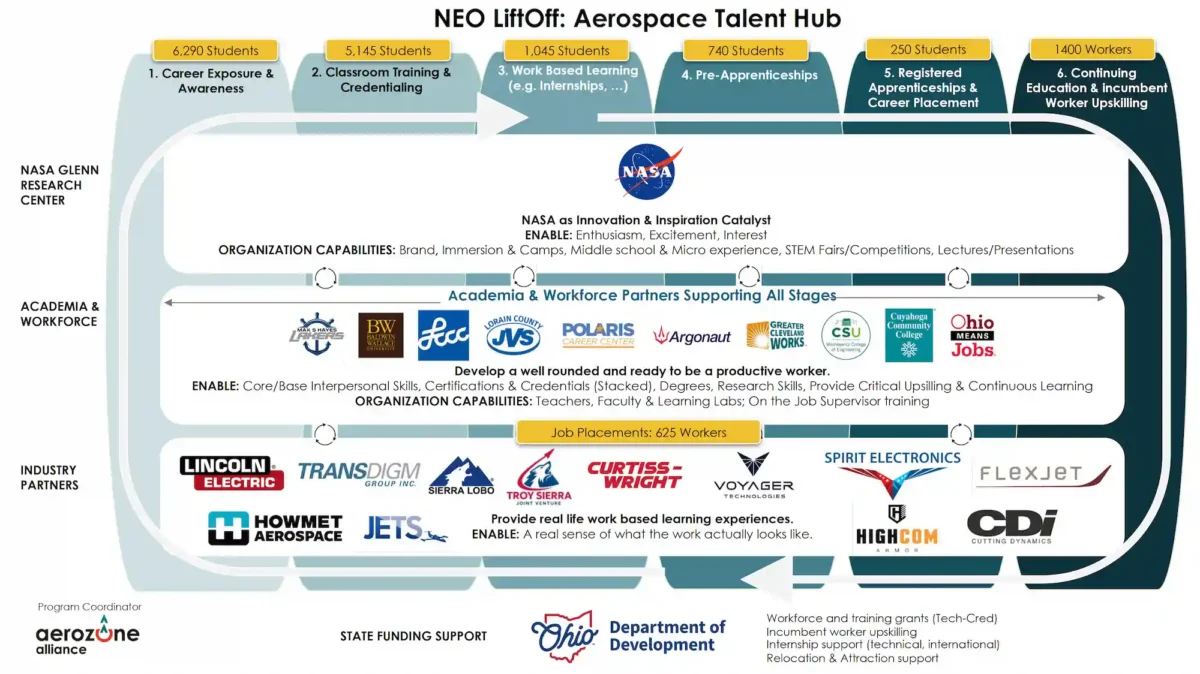
On the education and training side, partners include Polaris Career Center, Max Hayes High School, Lorain County Joint Vocational School, Argonaut Aviation and Maritime Academy, Cuyahoga Community College, Lorain County Community College, Cleveland State University, Baldwin Wallace University, Greater Cleveland Works, and Ohio Means Jobs.
On the industry side, key employers include Lincoln Electric, Voyager Technologies, Sierra Lobo, Troy Sierra, Curtiss-Wright, Spirit Electronics, Flexjet, TransDigm, Howmet Aerospace, Jets, Highcom Armor, and CDi.
What makes this effort different is not just who is at the table, but how the work is structured.
Because of the existing Aerozone Talent Partners framework, this coalition came together quickly. Each partner stepped into a clearly defined role across the full pathway from exposure to training to work based learning to placement.
The federal grant process provided a forcing function to align the group.
But the application was only the catalyst.
What we now have is something more.
A blueprint for coordination.
A blueprint for shared commitment.
And most importantly, a blueprint for what is now possible.
A Closing Invitation
No single institution will solve the challenges in front of us.
But a community can.
Each of us has a role to play.
For some, it will mean building pathways for students.
For others, it will mean aligning institutions.
For others, it will simply mean choosing to engage.
Join us.
The opportunity is real.
The moment is ours.
And what we build next is up to all of us.
Contact hmahalaha@aerozonealliance.org to learn more.

Hrishue Mahalaha
Executive Director
Aerozone Alliance